Winner-Take-All Politics by Paul Pierson & Jacob S. Hacker
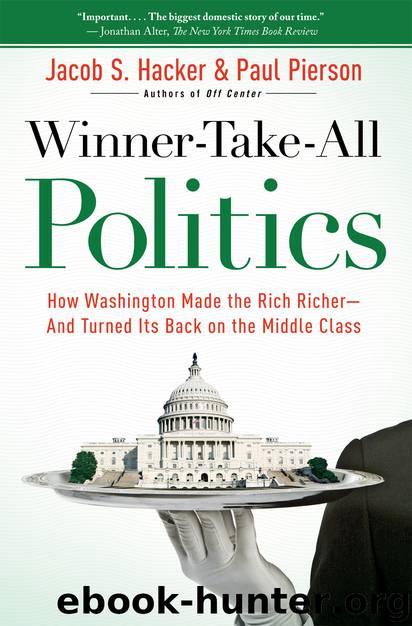
Author:Paul Pierson & Jacob S. Hacker [Pierson, Paul & Hacker, Jacob S.]
Language: eng
Format: epub
Tags: General, History, Politics, bought-and-paid-for, United States, Political Science, Non-Fiction, 20th Century, Business & Economics, Political Process, Economics, Business, Government, Public Policy, Economic Policy, Economic Conditions, Equality - United States, Equality, United States - Politics and Government - 1989, Capitalism, United States - Politics and Government - 1945-1989, Political Economy, Capitalism - United States, United States - Economic Policy
ISBN: 9781416588696
Publisher: Simon & Schuster
Published: 2010-09-14T04:00:00+00:00
Chapter 8
Building a Bridge to the Nineteenth Century
By all accounts, the 1980s was a great time to be rich. As chronicled in pop-culture movies like The Bonfire of the Vanities and Wall Street, it was a moment when capitalism’s winners took center stage. And as they did so, they revealed the contours of a new capitalism. Deal-makers and financial gamblers were supplanting captains of industry as the biggest winners of all.
But the 1980s was just a warm-up act. The staggering paychecks that generated such wonder and bewilderment would have been dismissed a few years later as decidedly second-rate. In the following decade the extraordinary transfer of income to the top truly shifted into high gear. Year after year, under Democratic administrations as well as Republican ones, the rich pulled rapidly away from everyone else. During the expansion of the 1990s (1993–2000), the average pre-tax real income of the top 0.01 percent nearly tripled, increasing more than 16 percent a year after adjusting for inflation. During the expansion of the 2000s (2002–2007), it more than doubled again, increasing more than 17 percent a year after inflation and exceeding $35 million in 2007.1 Broadland was dead. Richistan was born.
Not coincidentally, it was after 1990 that the full contours of winner-take-all politics came into focus. 1990, in fact, was a critical year. It was the year moderate Republicanism suffered its decisive, crushing defeat—at the hands of other Republicans. Its final standard-bearer, George H. W. Bush, would hold office two more years. Yet his brand of politics, and his presidency, were over, definitively repudiated by the ascendant, Gingrichled GOP. Ironically, this radical wing would ultimately achieve some of its greatest policy victories under the leadership of Bush’s son and namesake.
The Democrats, too, had changed with the times. True, the party never converted to the fervent tax-cutting religion of the GOP (although a substantial, often crucial, bloc was willing to support Republican tax cuts when they came up for a vote). Support for turbocharged, freewheeling markets was another matter. Those likely to raise doubts about these trends were still almost always Democrats. Yet Democrats at the commanding heights of their party were increasingly eager to show their friendliness to business and, especially, Wall Street. Critical aspects of the new winner-take-all economy received sustained, enthusiastic bipartisan support not just under George W. Bush, but also under Bill Clinton.
The wonder years of the winner-take-all economy began with the recession that brought down Bush the elder. They ended with a recession of far greater magnitude that discredited Bush the younger—and powerfully showcased the new economy’s true costs. Nothing better summed up the era, and its marriage of the economic and the political, than the résumés of the two men widely regarded as Clinton and Bush’s most influential secretaries of the treasury, Robert Rubin and Henry Paulson. Different in many ways, including party affiliation, each nonetheless developed (for a time) a reputation for sophisticated economic management. And each derived much of that reputation from a previous career at a
Download
This site does not store any files on its server. We only index and link to content provided by other sites. Please contact the content providers to delete copyright contents if any and email us, we'll remove relevant links or contents immediately.
International Integration of the Brazilian Economy by Elias C. Grivoyannis(103154)
The Radium Girls by Kate Moore(11990)
Turbulence by E. J. Noyes(7994)
Nudge - Improving Decisions about Health, Wealth, and Happiness by Thaler Sunstein(7671)
The Black Swan by Nassim Nicholas Taleb(7073)
Rich Dad Poor Dad by Robert T. Kiyosaki(6546)
Pioneering Portfolio Management by David F. Swensen(6264)
Man-made Catastrophes and Risk Information Concealment by Dmitry Chernov & Didier Sornette(5967)
Zero to One by Peter Thiel(5749)
Secrecy World by Jake Bernstein(4714)
Millionaire: The Philanderer, Gambler, and Duelist Who Invented Modern Finance by Janet Gleeson(4433)
The Age of Surveillance Capitalism by Shoshana Zuboff(4260)
Skin in the Game by Nassim Nicholas Taleb(4213)
The Money Culture by Michael Lewis(4152)
Bullshit Jobs by David Graeber(4151)
Skin in the Game: Hidden Asymmetries in Daily Life by Nassim Nicholas Taleb(3970)
The Dhandho Investor by Mohnish Pabrai(3731)
The Wisdom of Finance by Mihir Desai(3707)
Blockchain Basics by Daniel Drescher(3553)
